
 by
by 
The benefits of research-driven advances in handwashing, traditionally take considerable time to reach the nation’s restaurants. This May 12th meeting in Oak Park, Michigan attempts to be a game-changer with an early immersion into the rigors of FDA codification.
The SaniOnce handwash protocol has been thoroughly tested by an independent laboratory. It offers considerable advantages over current practices. This photo highlights its convenience factor in delivering superior results in waterless and water-short locations, common at temporary events and food trucks.
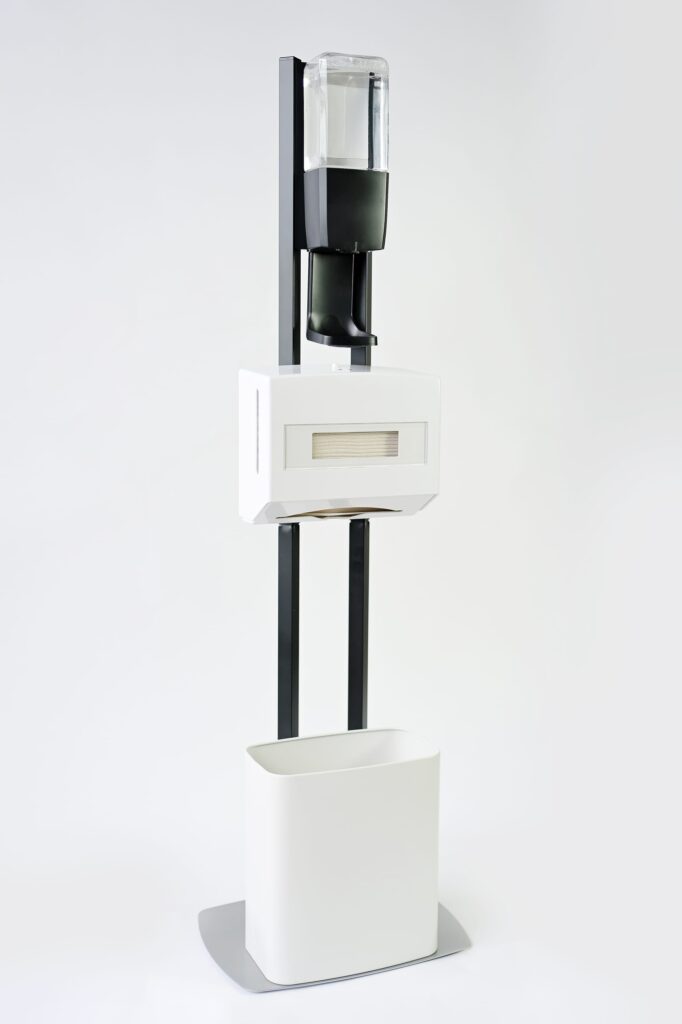
The SaniOnce Handwash Station
Short Title: Friction-aided Alcohol-Based Hand Antiseptic Handwash for use on light to moderately soiled hands where plumbed handsinks are unavailable at Temporary Food Events (TFEs) or Mobiles
Submitted by: Jim Arbogast
GLCFP ISSUE SUBMISSION
What is the issue you would like this conference to consider?
In situations where access to potable water via temporary handwashing stations is not possible, the CFP Guidance Document advocates for ceasing all food preparation operations and switching to the sale of pre-packaged foods. During these situations, the CFP Guidance Document advocates for use of an FDA approved alcohol-based hand sanitizing hand antiseptic in lieu of handwashing with soap and water1. Currently, the FDA Food Code does not allow for use of alcohol-based hand antiseptics (ABHA) plus paper towel (PT) handwashin lieu of washing hands with soap and water at temporary events.
ABHA, also known as hand sanitizers or in healthcare as alcohol-based hand rubs, can be used quite effectively2-4, especially by approximately doubling a normal dose and adding the friction of a paper towel (PT) finish5-7. Together, this ABHA + PT provides a simple, convenient and highly effective choice for those operators seeking to lower their risk of an outbreak. The combined pathogen kill and cleaning factors yields up to a 5-log reduction7. In 2009 Clark County Nevada Schools chose to use a similar ABHA handwash to continue food service during water outages. Their protocol, still in use approximately 15 years later, is ABHA + PT + a second application of ABHA.
The performance of hand antiseptics to reduce pathogens on hands of foodservice workers has been critically assessed in a published 2021 literature review8. The authors conclude: “Alcohol-based solutions are better than soap when soil is light to moderate”. A laboratory-controlled study shows both hand washing and hand antiseptic effectively reduce germs on hands and reduce transmission from cleaned hands to food.7 They found that the double dose of ABHA + PT handwash demonstrated significantly superior efficacy to hand washing with good technique in reducing pathogens on hands and in minimizing microbial transfer to food (fresh melon) after hand cleaning.
Handwashing guidance “when a facility has no operational handwashing sinks, but an alternative handwashing facility can be set up” was issued by a Conference for Food Protection Working Committee1. In those temporary situations they recommend setting up a temporary handwashing station, comprised of a clean and sanitized container to hold and dispense water (e.g., a sports-style water cooler or a food grade bucket with a spigot). The ABHA + PT handwash avoids sanitation risks in transferring potable water and potential hand contamination from the nearly uncleanable, manual plastic spigots. The lower water flows from this type of makeshift setup are also likely to result in skin dermatitis because of poor rinsing of the soap.
Public Health Significance:
Safe food and beverage service requires effective handwashing and is expected by the away-from-home public even when eating at temporary food event stations or at transitory food units (aka food trucks). The service is commonly located at distances well away from a plumbed handsink making it practically impossible for the staff to wash their hands without leaving the food and cash box unguarded. Without readily available handwashing, food service gloves cannot be changed hygienically. The employees (that must not be working when sick or with GI symptoms) at such food venues very rarely experience heavy hand soiling in these locations; however, they are often exposed to transient invisible microbes that may cause infection without effective hand hygiene at key moments.
RecommendedSolution:
The Conference recommends that section 5-203.11 of the current edition of the Food Code be amended as follows:
5-203.11
(A)(B)
(C) When FOOD exposure is limited and HANDWASHING SINKS are not conveniently located, such as at outdoor events, mobile or temporary food service events, EMPLOYEES may use a non-HANDWASHING SINK regimen of washing hands with alcohol-based hand antiseptic wherein the application is treated as a handwash with full scrubbing action for 20 seconds and then, while wet, wiped off with a fresh paper towel.
(1) Said hand antiseptic shall meet requirements of 2-301.16.
(2) Said hand antiseptic shall be pre-approved by the REGULATORY AUTHORITY in the PERMIT HOLDER’s written operating plan.
References:
- Conference for Food Protection (2014). Emergency Action Plan for Retail Food Establishments.
Available at: https://www.foodprotect.org/media/guide/Emergency%20Action%20Plan%20for%20Retail%20food%20Est.pdf
- Boyce, J. M., Pittet, D. (2002). “Guideline for Hand Hygiene in Healthcare Settings. Recommendations of the Healthcare Infection Control Practices Advisory Committee and the HICPAC/SHEA/APIC/ IDSA Hand Hygiene Task Force. Society for Healthcare Epidemiology of America/Association for Professionals in Infection Control/Infectious Diseases Society of America.”
- Pittet, D. (2009). “World Health Organization guidelines for hand hygiene in healthcare.” Geneva: World Health Organization website issue.
- Glowicz, J. B., Landon, E., Sickbert-Bennett, E. E., Aiello, A. E., deKay K., Hoffmann K. K., Maragakis, L., Olmsted R. N., Polgreen, P. M., Trexler, P. A., VanAmringe, M. A., Wood, A. R., Yokoe D., Ellingson, K. D. (2023). “SHEA/IDSA/APIC Practice Recommendation: Strategies to prevent healthcare-associated infections through hand hygiene: 2022 Update.” Infection Control and Hospital Epidemiology, 44(3):355–376.
- Edmonds, S. L., Mann, J., McCormack, R. M., Macinga, D. R., Fricker C. M., Arbogast, J. W., Dolan, M. J. (2010). “SaniTwice: A Novel Approach to Hand Hygiene for Reducing Bacterial Contamination on Hands When Soap and Water Are Unavailable”, Journal of Food Protection, 73(12), 2296-2300.
- Fabiszewski de Aceituno, A., Bartz, F. E., Hodge, D. W., Shumaker, D. J., Grubb, J. E., Arbogast, J. W., Davila-Avina, J., Venegas, F., Heredia, N., Garcia, S., Leon, J. S. (2015). “Ability of Hand Hygiene Interventions Using Alcohol-Based Hand Sanitizers and Soap To Reduce Microbial Load on Farmworker Hands Soiled during Harvest”, Journal of Food Protection, 78(11), 2024-2032.
- Arbogast, J. W., Comstock C., Beausoleil, C. M., Buckley, D. A., Lyon, S. A., Marsden, J., Schaffner, D. W. (2026). Comparative Efficacy of Hand Wash Lather Times of 5 to 20 Seconds vs. Alcohol-Based Hand Sanitizer Application Approaches by an In Vivo Cross-Contamination Test Method, Journal of Food Protection, 2026 Mar;89(3):100698.
- Boyce, J. M., & Schaffner, D. W. (2021). Scientific Evidence Supports the Use of Alcohol-Based Hand Sanitizers as an Effective Alternative to Hand Washing in Retail Food and Food Service Settings When Heavy Soiling Is Not Present on Hands. Journal of Food Protection, 84(5), 781–801.
Submitter to Great Lakes Conference for Food Protection: James W. Arbogast, PhD (presenter)
